
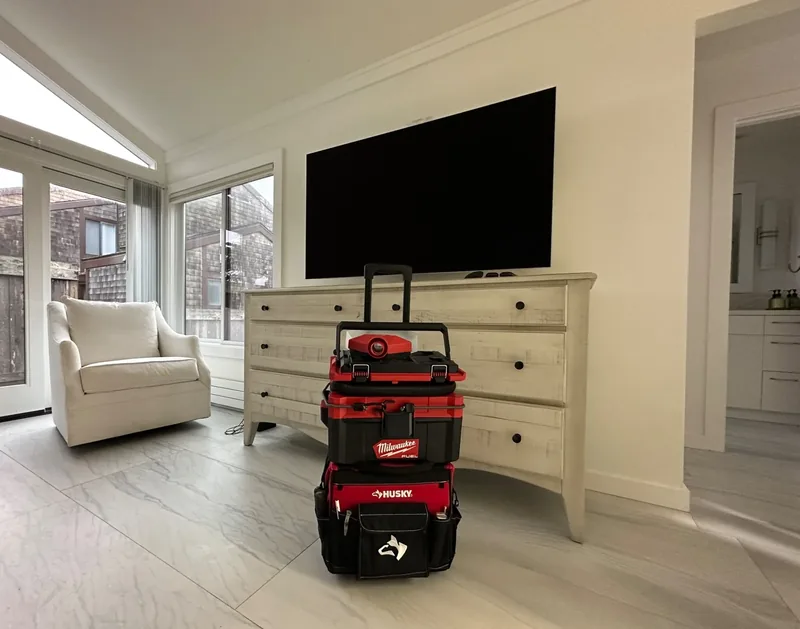
Choose the viewing position before the empty wall
The largest blank wall is not always the best TV location. Start with the seats used most often and look for a screen position that does not require prolonged sideways viewing. Then consider windows, doorways, furniture and access to power. A successful layout balances these constraints instead of solving only one.
Compare two or three candidate locations
Place a paper or tape outline at each candidate spot. Sit down, open curtains and switch on the usual lamps. Check whether people will cross directly between the sofa and screen. A wall opposite a bright window may create reflections; moving the TV to a side wall can help, but compare the seating angle before deciding.
When a corner works
A full-motion mount can bring a screen out from a corner, provided the bracket is approved for the attachment and has enough extension. The larger the screen, the more clearance it needs to turn without striking either wall. Measure the entire swept path, including the cables and soundbar, rather than only the folded position.
In a small room, a shallower bracket may preserve useful walking space. In an open-plan room, swivel can serve two viewing areas, but a TV turned toward one area will not necessarily look equally good from the other.
Eliminate impractical options
- Reject locations exposed to heat or moisture outside the equipment's permitted conditions.
- Verify the structure behind decorative panels, tile or plaster.
- Find a workable power arrangement without hiding an ordinary power cord inside the wall.
- Keep the screen, bracket and wiring accessible for maintenance.
Send a wide room photo and close-ups of the intended wall when requesting TV mounting. Include where you sit and whether viewing from a second area matters. Those details make the choice between a fixed, tilting or moving bracket much clearer.